

Business analysis is the fact-based understanding of a business to uncover the real reasons behind its performance, in order to develop plans to grow it. Acumen, a Filipino-led consulting company, structures that work with its W8 framework, which asks three questions in order—What is happening? Why is this happening? What now?—and takes a team from performance data to a prioritized set of strategic imperatives.
Business analysis has always been a dreaded activity—especially among marketing practitioners. This is not surprising, considering that many marketers are right-brained people. Being creative and artistic, they would more intuitively spend their time brainstorming and creating innovative ideas to entice consumers to use their brand. However, as marketers and salespeople develop plans, a constant underlying question on their mind is: “Will this idea work and build the business?” This is an important question to ask—even more so now that the market is so volatile due to the pandemic and businesses just cannot afford to waste resources on plans that do not work.
Good business strategy and plans are anchored on sound business analysis. While a few businesses might get lucky and come up with an enticing consumer plan without the benefit of any business analysis, this type of risk-taking usually does not work. Businesses that take this kind of risk tend to waste valuable resources, stagnate, and eventually lose revenue and market share. Conversely, businesses that take a more informed and strategic approach to these plans through business analysis are able to uncover and capture better opportunities.
What is business analysis?
Business analysis is the fact-based understanding of a business to uncover the real reasons behind its performance, in order to develop plans to grow the business.
These three parts—the facts, the real reasons behind performance, and the plans to grow—guide how one should approach business analysis.
What is the W8 framework?
The W8 framework is the guide we use at Acumen for business analysis. Like the definition above, it is divided into three sections:
- What is happening?
- Why is this happening?
- What now?
Each section produces the input for the next: an identified problem statement, then a set of strategic themes, then a prioritized list of strategic imperatives.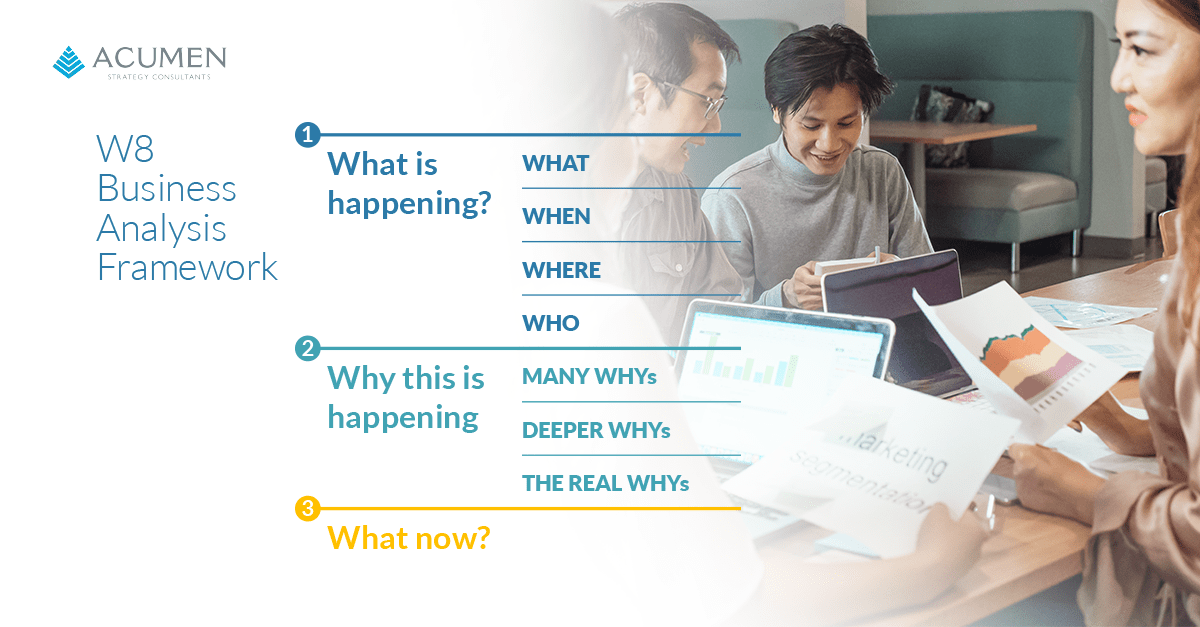
Step 1: What is happening? Situational analysis and the problem statement
The first step defines what is happening through a situational analysis and ends with an identified problem statement: the issue the business should prioritize understanding and acting upon.
Situational analysis: what, when, where, and who
To define what is happening, one does a situational analysis by asking the key questions—WHAT, WHEN, WHERE, and WHO—using available business and consumer data.
This section always starts with the main business metrics: revenue, market share, and profit. Using revenue as an example for our WHAT, one can assess its performance by understanding what drives it, such as:
- WHEN: revenue performance over a time period
- WHERE: revenue performance within an area, channel, segment, and category
- WHO: revenue performance within a consumer segment
It is quite important to do the analysis all the way to the WHO, since consumers are the brand’s source of revenue. Throughout the analysis, it is also important to explore performance across all available segments in the WHEN, WHERE, and WHO, as this helps identify segments where the business is growing or declining.
Overall assessment of the key metric
Once the situational analysis is complete, one should do an overall assessment of the identified business metric by:
- Describing its overall performance (e.g., growing, stagnating, declining)
- Identifying the reasons behind this performance
- Capturing key findings on what is and is not working
Developing the problem statement
The key output of determining what is happening is an identified problem statement, which captures what the business should prioritize understanding further and then acting upon. The problem statement should target the metrics that have the biggest potential to impact and grow the business.
It is important to remember that a problem statement related to revenue and market share should always include the WHO (the consumer), as consumers are the ones who need to be influenced and convinced to use the brand. In addition, a problem statement can be either a good problem or a bad problem.
A good problem harnesses one’s strength or capitalizes on an opportunity, such as: “How can the brand sustain or even accelerate its growth in consumer segment A?”
A bad problem requires fixing a current business issue, such as: “How can the brand arrest the decline of its user base in consumer segment A?”
Once you have an identified problem statement, you are ready to move on to the next section of the W8 framework.
Step 2: Why is this happening? Root cause analysis
In this section, one does a root cause analysis by unearthing the MANY WHYs, the DEEPER WHYs, and the REAL WHYs. To keep the analysis efficient, it is the identified problem statement that is subjected to root cause analysis.
Understanding the key drivers that influence consumer behavior
At Acumen, we have a tool called the Business Drivers Map that facilitates the WHY analysis. The Business Drivers Map helps form a comprehensive understanding of the consumer by determining the key drivers that influence their behavior in using the brand. Hence, one should assess the brand’s performance across the identified consumer behavior drivers.
Analyzing the marketing mix (7Ps) and market factors (5Cs)
The next step is to assess the effectiveness of the brand’s marketing mix, or its controllable factors (7Ps), in delivering the desired consumer behavior drivers. It is also important to see the impact of market factors that affect performance, or the brand’s uncontrollable factors (5Cs). The result of this analysis is a list of issues and opportunities across the consumer behavior drivers, the brand’s marketing mix, and its market factors.
Clustering issues into strategic themes
We use a clustering technique that groups issues and opportunities together to formulate key strategic themes. The key output of this section is a list of strategic themes, which enables one to have a deep and insightful understanding of the identified problem statement.
Step 3: What now? Prioritizing strategic imperatives
The third step identifies the key strategic imperatives—the actions the business must take to address the identified problem statement—and then prioritizes them. Using the strategic themes as inputs, imperatives that address one or more of those themes can be carefully identified.
Once the imperatives have been identified, they are prioritized using criteria that score each imperative by its commercial potential, consumer impact, and the resources required to implement it.
With this section complete, teams can confidently move on to developing each of these ideas into something creative and relevant—knowing that they are anchored on important consumer needs and are likely to make a significant impact in building the business.
How Acumen applies the W8 framework with clients
We have successfully used this business analysis process to help our clients develop their short-, mid-, and long-term strategies, identify new marketing innovation, turn around a declining brand, enter new categories, transform their business, and build their organizational capability. You, too, can grow your business effectively, efficiently, and with confidence amidst a challenging market environment by starting with sound business analysis.
Frequently asked questions
What is business analysis?
Business analysis is the fact-based understanding of a business to uncover the real reasons behind its performance, in order to develop plans to grow it. Businesses that plan without it tend to waste resources, stagnate, and lose revenue and market share, while those that take an informed approach through business analysis are able to uncover and capture better opportunities.
What is the W8 framework?
The W8 framework is the guide Acumen uses for business analysis. It works through three questions—What is happening? Why is this happening? What now?—and each step produces the input for the next: an identified problem statement, a set of strategic themes, and a prioritized list of strategic imperatives.
How do you write a problem statement for business analysis?
A problem statement should target the metrics with the biggest potential to impact and grow the business. When it concerns revenue or market share, it should always name the consumer, because consumers are the ones the brand needs to influence and convince to use it. A problem statement can frame either a good problem, which builds on a strength or opportunity, or a bad problem, which fixes a current business issue.
How are strategic imperatives prioritized?
Strategic imperatives are prioritized by scoring each one on its commercial potential, its consumer impact, and the resources required to implement it. The imperatives themselves are identified from the strategic themes produced by the root cause analysis, so each one addresses one or more of those themes.
← Back to Insights